
IOO YEARS AGO THIS WEEK 30 MARCH - 5 APRIL 1926
This week's many stories include the unveiling of the St Helens War Memorial, the woman who caused a commotion in St Helens County Court, the stone throwing at a train in Clock Face, the dispute over a Windleshaw Road house, the Parr mother who lost five sons in the war and the man that was dubbed a recurring decimal makes his 55th appearance in court.
Children throwing stones at trains or attempting other acts of vandalism on the railway seems to have been much more prevalent in the past than today. But catching the offenders and proving their guilt was always a difficult task. On March 30th an attempt to prosecute an unnamed boy in St Helens Juvenile Court was foiled by him having an alibi.
The lad had been accused of throwing a stone at a train travelling between Clock Face and St Helens Station. A guard who was looking out of the window at the time had his face cut and he needed treatment at Sutton Oak Station. But the boy's aunt gave her nephew an alibi and the case had to be dismissed.
The St Helens Reporter in 1925 had described William Owen as a bit of an enigma to the local magistrates, saying that from time to time he "pops up like a recurring decimal". The labourer regularly appeared in court charged with "lodging out", which could mean sleeping in the open air or on some premises without permission. In Owen's case his chosen venue was usually the Sutton Road Brick Works.
Last week he had appeared in court facing the usual lodging out charge and was bound over upon a promise that he would go to Whiston Institution – as the workhouse was now officially known – and stay there for at least a month. But Owen had only lasted a day or two and had resumed his sleeping out habits and on the 30th returned to St Helens Police Court to make his 55th appearance.
The magistrates told Owen that if he could not keep his promise to remain in the workhouse he must go to prison for three months. In 1925 he had been sentenced to 9 months in prison.
Schoolteachers often had very lengthy teaching careers, partly because they had often started as pupil teachers in their mid-teens. On the 31st Edward Nicholls retired as headmaster of the Rainford C of E Schools after forty-eight years of scholastic service. Mr Nicholls had only been at Rainford for 5 years but had previously been the head at Crank School for 29 years.
He said that when he began his teaching career he was only paid 1 shilling a week. That suggests that he had indeed been a pupil teacher in his early days, responsible for teaching younger children while still learning himself.
Recently I described how the war memorial in Victoria Square was set to be unveiled on April 4th 1926, which would be Easter Sunday. However, the Mayor's Memorial Fund was still short of its fundraising total. On the 31st it was revealed that miner's wife Elizabeth Davies – who had lost five of her sons in WW1 – had made another donation.
Mrs Davies from Chancery Lane in Parr had heard that the mayoral fund was £170 short of its target. So she had waited for an hour to give Alderman Thomas Hamblett a £1 donation – her third contribution to the fund. Lord Derby was so moved by this story after being told of it by the Mayor that he immediately wrote out another cheque for £50. Seven years later after Elizabeth had died, the St Helens Reporter's obituary article was headlined "The Passing of A Noble Mother".
Thomas Schofield offered an interesting excuse in St Helens Police Court on the 31st after being charged with being on enclosed premises. The man of no fixed abode was discovered in the yard at the rear of Hunter's pawnshop in Park Road. Schofield's excuse was that he had gone into the yard for a sleep but had climbed over the wrong wall. His excuse was not accepted and Schofield was sentenced to 3 months hard labour.
It has to be said that the vast majority of cases that were heard every Wednesday at St Helens County Court in East Street were pretty boring. Usually they concerned someone suing somebody else for an unpaid debt. However, on the 31st an unnamed woman sitting at the back of the court livened up proceedings by shrieking at the top of her voice, "It is nothing but a pack of lies!"
The outburst occurred when Turner Rigby of Hollytree Farm in Haydock was giving evidence against James Lyon. The miner from Haydock Old Lane was being sued for 17s 10d for allotment rent arrears and for milk that had been supplied. Mr Rigby responded to the woman's outburst by telling the judge, "This is the kind of thing I have had to put up with." She then said: "Wait till you leave the court. I will be outside to meet you."
The woman was then ushered out and Judge Thomas later gave judgment for Turner Rigby for 6 shillings. But the interrupter was true to her word and was waiting for Mr Rigby as he left the courtroom, although he did not have to go outside to meet her. She was waiting for him on the stairs and what was described as a commotion took place. The business of the court had to be suspended until the usher succeeded in clearing everyone away from the passages. Very likely a sequel to what took place would occur in the coming days in the Police Court.
People suing one another for money that they claimed to be owed were the most common types of cases heard in the County Court. But so-called ejectment hearings were also popular. Although often they were not about unpaid rent but simply someone who owned just one or two houses wanting to get their tenant out so that they, or a family member, could move in. And those who owned the house were often themselves living in overcrowded accommodation.
However, their tenant would not want to leave because the housing shortage meant it was very difficult for them to find another place to live. That was the premise of another hearing at the County Court in which two widows fought for possession of a house in Windleshaw Road. Owner Gertude Propper wanted her tenant, a Mrs Isherwood, to vacate her house so that she could move in. However, the latter said that although she was fully prepared to move out, she could not find another place.
This type of case placed the judge in a very difficult position and Judge Thomas said there was great hardship on both sides. And clearly not knowing what to do, he decided to adjourn the case for three months hoping that matters would resolve themselves.
April 2nd was Good Friday and the Ravenhead Military Band gave a performance at Carr Mill. An advert promoting the event also said: "For the Easter Holidays. Visit Carr Mill. Boating, Fishing, Motor-Boat Trips. Amusements, Refreshments. Finest lakes in the North of England."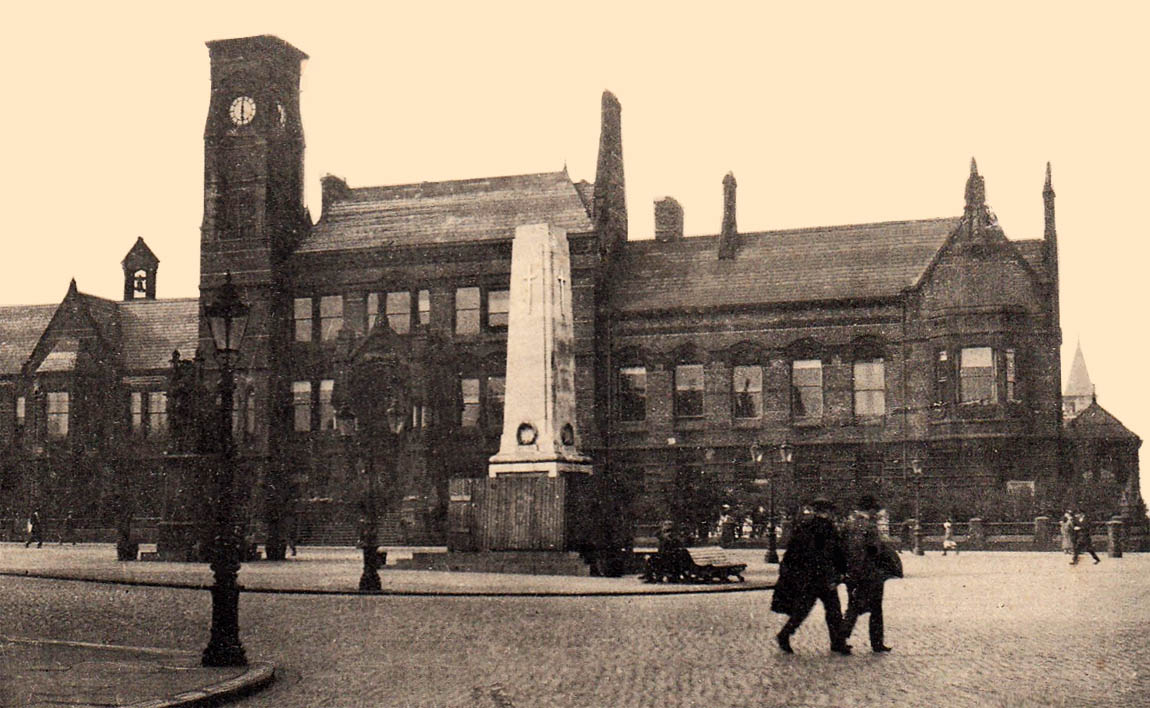 The 4th was Easter Sunday and it was also the day chosen for the unveiling of the war memorial in Victoria Square. It had been nearly two years since the obelisk on a granite base had been installed. But the collation and inscribing on special panels of nearly 2,500 names of fallen soldiers had delayed the unveiling.
A huge number of persons had gathered outside the Town Hall to participate in the ceremony, which began with a religious service. The band and buglers of the St Helens companies of the Royal Engineers were also present and, alongside church and civic leaders, was Elizabeth Davies, the woman who had lost five sons in the war. Alderman Thomas Hamblett, the mayor of St Helens, gave this address:
"We are assembled to perform a solemn duty and to fulfil an obligation which has long been delayed – an obligation to place in some conspicuous position a permanent memorial of those townsmen who gave their lives in the great struggle of 1914 to 1918. Although it is nearly twelve years since war was declared and nearly eight since the Armistice was signed, the dreadful experiences of those four years are still painful memories.
"There are nearly 2,500 of our townspeople who never returned. Their names are inscribed on these memorial stones. We have come to honour them not only for the sacrifices they made, but for the ideals for which they fought; the ideals of justice and honour, believing that it was a war to end war." Mrs Davies laid a wreath on the cenotaph which bore the inscription: "In proud and solemn memory of the men of St. Helens who gave their lives in the Great War – Mrs. Davies."
St Helens Reporter courtesy St Helens Archive Service at Eccleston Library
Next Week's stories will include the Parr father's lifesaving blood transfusion, the drowning in Taylor Park lake, the boy's brainless office theft and the planned eviction of the 100 Sutton poison gas cottagers.
Children throwing stones at trains or attempting other acts of vandalism on the railway seems to have been much more prevalent in the past than today. But catching the offenders and proving their guilt was always a difficult task. On March 30th an attempt to prosecute an unnamed boy in St Helens Juvenile Court was foiled by him having an alibi.
The lad had been accused of throwing a stone at a train travelling between Clock Face and St Helens Station. A guard who was looking out of the window at the time had his face cut and he needed treatment at Sutton Oak Station. But the boy's aunt gave her nephew an alibi and the case had to be dismissed.
The St Helens Reporter in 1925 had described William Owen as a bit of an enigma to the local magistrates, saying that from time to time he "pops up like a recurring decimal". The labourer regularly appeared in court charged with "lodging out", which could mean sleeping in the open air or on some premises without permission. In Owen's case his chosen venue was usually the Sutton Road Brick Works.
Last week he had appeared in court facing the usual lodging out charge and was bound over upon a promise that he would go to Whiston Institution – as the workhouse was now officially known – and stay there for at least a month. But Owen had only lasted a day or two and had resumed his sleeping out habits and on the 30th returned to St Helens Police Court to make his 55th appearance.
The magistrates told Owen that if he could not keep his promise to remain in the workhouse he must go to prison for three months. In 1925 he had been sentenced to 9 months in prison.
Schoolteachers often had very lengthy teaching careers, partly because they had often started as pupil teachers in their mid-teens. On the 31st Edward Nicholls retired as headmaster of the Rainford C of E Schools after forty-eight years of scholastic service. Mr Nicholls had only been at Rainford for 5 years but had previously been the head at Crank School for 29 years.
He said that when he began his teaching career he was only paid 1 shilling a week. That suggests that he had indeed been a pupil teacher in his early days, responsible for teaching younger children while still learning himself.
Recently I described how the war memorial in Victoria Square was set to be unveiled on April 4th 1926, which would be Easter Sunday. However, the Mayor's Memorial Fund was still short of its fundraising total. On the 31st it was revealed that miner's wife Elizabeth Davies – who had lost five of her sons in WW1 – had made another donation.
Mrs Davies from Chancery Lane in Parr had heard that the mayoral fund was £170 short of its target. So she had waited for an hour to give Alderman Thomas Hamblett a £1 donation – her third contribution to the fund. Lord Derby was so moved by this story after being told of it by the Mayor that he immediately wrote out another cheque for £50. Seven years later after Elizabeth had died, the St Helens Reporter's obituary article was headlined "The Passing of A Noble Mother".
Thomas Schofield offered an interesting excuse in St Helens Police Court on the 31st after being charged with being on enclosed premises. The man of no fixed abode was discovered in the yard at the rear of Hunter's pawnshop in Park Road. Schofield's excuse was that he had gone into the yard for a sleep but had climbed over the wrong wall. His excuse was not accepted and Schofield was sentenced to 3 months hard labour.
It has to be said that the vast majority of cases that were heard every Wednesday at St Helens County Court in East Street were pretty boring. Usually they concerned someone suing somebody else for an unpaid debt. However, on the 31st an unnamed woman sitting at the back of the court livened up proceedings by shrieking at the top of her voice, "It is nothing but a pack of lies!"
The outburst occurred when Turner Rigby of Hollytree Farm in Haydock was giving evidence against James Lyon. The miner from Haydock Old Lane was being sued for 17s 10d for allotment rent arrears and for milk that had been supplied. Mr Rigby responded to the woman's outburst by telling the judge, "This is the kind of thing I have had to put up with." She then said: "Wait till you leave the court. I will be outside to meet you."
The woman was then ushered out and Judge Thomas later gave judgment for Turner Rigby for 6 shillings. But the interrupter was true to her word and was waiting for Mr Rigby as he left the courtroom, although he did not have to go outside to meet her. She was waiting for him on the stairs and what was described as a commotion took place. The business of the court had to be suspended until the usher succeeded in clearing everyone away from the passages. Very likely a sequel to what took place would occur in the coming days in the Police Court.
People suing one another for money that they claimed to be owed were the most common types of cases heard in the County Court. But so-called ejectment hearings were also popular. Although often they were not about unpaid rent but simply someone who owned just one or two houses wanting to get their tenant out so that they, or a family member, could move in. And those who owned the house were often themselves living in overcrowded accommodation.
However, their tenant would not want to leave because the housing shortage meant it was very difficult for them to find another place to live. That was the premise of another hearing at the County Court in which two widows fought for possession of a house in Windleshaw Road. Owner Gertude Propper wanted her tenant, a Mrs Isherwood, to vacate her house so that she could move in. However, the latter said that although she was fully prepared to move out, she could not find another place.
This type of case placed the judge in a very difficult position and Judge Thomas said there was great hardship on both sides. And clearly not knowing what to do, he decided to adjourn the case for three months hoping that matters would resolve themselves.
April 2nd was Good Friday and the Ravenhead Military Band gave a performance at Carr Mill. An advert promoting the event also said: "For the Easter Holidays. Visit Carr Mill. Boating, Fishing, Motor-Boat Trips. Amusements, Refreshments. Finest lakes in the North of England."
A huge number of persons had gathered outside the Town Hall to participate in the ceremony, which began with a religious service. The band and buglers of the St Helens companies of the Royal Engineers were also present and, alongside church and civic leaders, was Elizabeth Davies, the woman who had lost five sons in the war. Alderman Thomas Hamblett, the mayor of St Helens, gave this address:
"We are assembled to perform a solemn duty and to fulfil an obligation which has long been delayed – an obligation to place in some conspicuous position a permanent memorial of those townsmen who gave their lives in the great struggle of 1914 to 1918. Although it is nearly twelve years since war was declared and nearly eight since the Armistice was signed, the dreadful experiences of those four years are still painful memories.
"There are nearly 2,500 of our townspeople who never returned. Their names are inscribed on these memorial stones. We have come to honour them not only for the sacrifices they made, but for the ideals for which they fought; the ideals of justice and honour, believing that it was a war to end war." Mrs Davies laid a wreath on the cenotaph which bore the inscription: "In proud and solemn memory of the men of St. Helens who gave their lives in the Great War – Mrs. Davies."
St Helens Reporter courtesy St Helens Archive Service at Eccleston Library
Next Week's stories will include the Parr father's lifesaving blood transfusion, the drowning in Taylor Park lake, the boy's brainless office theft and the planned eviction of the 100 Sutton poison gas cottagers.
This week's many stories include the unveiling of the St Helens War Memorial, the woman who caused a commotion in St Helens County Court, the stone throwing at a train in Clock Face, the dispute over a Windleshaw Road house, the Parr mother who lost five sons in the war and the man that was dubbed a recurring decimal makes his 55th appearance in court.
Children throwing stones at trains or attempting other acts of vandalism on the railway seems to have been much more prevalent in the past than today.
But catching the offenders and proving their guilt was always a difficult task.
On March 30th an attempt to prosecute an unnamed boy in St Helens Juvenile Court was foiled by him having an alibi.
The lad had been accused of throwing a stone at a train travelling between Clock Face and St Helens Station.
A guard who was looking out of the window at the time had his face cut and he needed treatment at Sutton Oak Station.
But the boy's aunt gave her nephew an alibi and the case had to be dismissed.
The St Helens Reporter in 1925 had described William Owen as a bit of an enigma to the local magistrates, saying that from time to time he "pops up like a recurring decimal".
The labourer regularly appeared in court charged with "lodging out", which could mean sleeping in the open air or on some premises without permission.
In Owen's case his chosen venue was usually the Sutton Road Brick Works.
Last week he had appeared in court facing the usual lodging out charge and was bound over upon a promise that he would go to Whiston Institution – as the workhouse was now officially known – and stay there for at least a month.
But Owen had only lasted a day or two and had resumed his sleeping out habits and on the 30th returned to St Helens Police Court to make his 55th appearance.
The magistrates told Owen that if he could not keep his promise to remain in the workhouse he must go to prison for three months. In 1925 he had been sentenced to 9 months in prison.
Schoolteachers often had very lengthy teaching careers, partly because they had often started as pupil teachers in their mid-teens.
On the 31st Edward Nicholls retired as headmaster of the Rainford C of E Schools after forty-eight years of scholastic service.
Mr Nicholls had only been at Rainford for 5 years but had previously been the head at Crank School for 29 years.
He said that when he began his teaching career he was only paid 1 shilling a week.
That suggests that he had indeed been a pupil teacher in his early days, responsible for teaching younger children while still learning himself.
Recently I described how the war memorial in Victoria Square was set to be unveiled on April 4th 1926, which would be Easter Sunday.
However, the Mayor's Memorial Fund was still short of its fundraising total.
On the 31st it was revealed that miner's wife Elizabeth Davies – who had lost five of her sons in WW1 – had made another donation.
Mrs Davies from Chancery Lane in Parr had heard that the mayoral fund was £170 short of its target.
So she had waited for an hour to give Alderman Thomas Hamblett a £1 donation – her third contribution to the fund.
Lord Derby was so moved by this story after being told of it by the Mayor that he immediately wrote out another cheque for £50.
Seven years later after Elizabeth had died, the St Helens Reporter's obituary article was headlined "The Passing of A Noble Mother".
Thomas Schofield offered an interesting excuse in St Helens Police Court on the 31st after being charged with being on enclosed premises.
The man of no fixed abode was discovered in the yard at the rear of Hunter's pawnshop in Park Road.
Schofield's excuse was that he had gone into the yard for a sleep but had climbed over the wrong wall.
His excuse was not accepted and Schofield was sentenced to 3 months hard labour.
It has to be said that the vast majority of cases that were heard every Wednesday at St Helens County Court in East Street were pretty boring. Usually they concerned someone suing somebody else for an unpaid debt.
However, on the 31st an unnamed woman sitting at the back of the court livened up proceedings by shrieking at the top of her voice, "It is nothing but a pack of lies!"
The outburst occurred when Turner Rigby of Hollytree Farm in Haydock was giving evidence against James Lyon.
The miner from Haydock Old Lane was being sued for 17s 10d for allotment rent arrears and for milk that had been supplied.
Mr Rigby responded to the woman's outburst by telling the judge, "This is the kind of thing I have had to put up with." She then said: "Wait till you leave the court. I will be outside to meet you."
The woman was then ushered out and Judge Thomas later gave judgment for Turner Rigby for 6 shillings.
But the interrupter was true to her word and was waiting for Mr Rigby as he left the courtroom, although he did not have to go outside to meet her.
She was waiting for him on the stairs and what was described as a commotion took place.
The business of the court had to be suspended until the usher succeeded in clearing everyone away from the passages.
Very likely a sequel to what took place would occur in the coming days in the Police Court.
People suing one another for money that they claimed to be owed were the most common types of cases heard in the County Court. But so-called ejectment hearings were also popular.
Although often they were not about unpaid rent but simply someone who owned just one or two houses wanting to get their tenant out so that they, or a family member, could move in.
And those who owned the house were often themselves living in overcrowded accommodation.
However, their tenant would not want to leave because the housing shortage meant it was very difficult for them to find another place to live.
That was the premise of another hearing at the County Court in which two widows fought for possession of a house in Windleshaw Road.
Owner Gertude Propper wanted her tenant, a Mrs Isherwood, to vacate her house so that she could move in.
However, the latter said that although she was fully prepared to move out, she could not find another place.
This type of case placed the judge in a very difficult position and Judge Thomas said there was great hardship on both sides.
And clearly not knowing what to do, he decided to adjourn the case for three months hoping that matters would resolve themselves.
April 2nd was Good Friday and the Ravenhead Military Band gave a performance at Carr Mill.
An advert promoting the event also said: "For the Easter Holidays. Visit Carr Mill. Boating, Fishing, Motor-Boat Trips. Amusements, Refreshments. Finest lakes in the North of England."
The 4th was Easter Sunday and it was also the day chosen for the unveiling of the war memorial in Victoria Square.
It had been nearly two years since the obelisk on a granite base had been installed.
But the collation and inscribing on special panels of nearly 2,500 names of fallen soldiers had delayed the unveiling.
A huge number of persons had gathered outside the Town Hall to participate in the ceremony, which began with a religious service.
The band and buglers of the St Helens companies of the Royal Engineers were also present and, alongside church and civic leaders, was Elizabeth Davies, the woman who had lost five sons in the war.
Alderman Thomas Hamblett, the mayor of St Helens, gave this address:
"We are assembled to perform a solemn duty and to fulfil an obligation which has long been delayed – an obligation to place in some conspicuous position a permanent memorial of those townsmen who gave their lives in the great struggle of 1914 to 1918.
"Although it is nearly twelve years since war was declared and nearly eight since the Armistice was signed, the dreadful experiences of those four years are still painful memories.
"There are nearly 2,500 of our townspeople who never returned. Their names are inscribed on these memorial stones.
"We have come to honour them not only for the sacrifices they made, but for the ideals for which they fought; the ideals of justice and honour, believing that it was a war to end war."
Mrs Davies laid a wreath on the cenotaph which bore the inscription: "In proud and solemn memory of the men of St. Helens who gave their lives in the Great War – Mrs. Davies."
St Helens Reporter courtesy St Helens Archive Service at Eccleston Library
Next Week's stories will include the Parr father's lifesaving blood transfusion, the drowning in Taylor Park lake, the boy's brainless office theft and the planned eviction of the 100 Sutton poison gas cottagers.
Children throwing stones at trains or attempting other acts of vandalism on the railway seems to have been much more prevalent in the past than today.
But catching the offenders and proving their guilt was always a difficult task.
On March 30th an attempt to prosecute an unnamed boy in St Helens Juvenile Court was foiled by him having an alibi.
The lad had been accused of throwing a stone at a train travelling between Clock Face and St Helens Station.
A guard who was looking out of the window at the time had his face cut and he needed treatment at Sutton Oak Station.
But the boy's aunt gave her nephew an alibi and the case had to be dismissed.
The St Helens Reporter in 1925 had described William Owen as a bit of an enigma to the local magistrates, saying that from time to time he "pops up like a recurring decimal".
The labourer regularly appeared in court charged with "lodging out", which could mean sleeping in the open air or on some premises without permission.
In Owen's case his chosen venue was usually the Sutton Road Brick Works.
Last week he had appeared in court facing the usual lodging out charge and was bound over upon a promise that he would go to Whiston Institution – as the workhouse was now officially known – and stay there for at least a month.
But Owen had only lasted a day or two and had resumed his sleeping out habits and on the 30th returned to St Helens Police Court to make his 55th appearance.
The magistrates told Owen that if he could not keep his promise to remain in the workhouse he must go to prison for three months. In 1925 he had been sentenced to 9 months in prison.
Schoolteachers often had very lengthy teaching careers, partly because they had often started as pupil teachers in their mid-teens.
On the 31st Edward Nicholls retired as headmaster of the Rainford C of E Schools after forty-eight years of scholastic service.
Mr Nicholls had only been at Rainford for 5 years but had previously been the head at Crank School for 29 years.
He said that when he began his teaching career he was only paid 1 shilling a week.
That suggests that he had indeed been a pupil teacher in his early days, responsible for teaching younger children while still learning himself.
Recently I described how the war memorial in Victoria Square was set to be unveiled on April 4th 1926, which would be Easter Sunday.
However, the Mayor's Memorial Fund was still short of its fundraising total.
On the 31st it was revealed that miner's wife Elizabeth Davies – who had lost five of her sons in WW1 – had made another donation.
Mrs Davies from Chancery Lane in Parr had heard that the mayoral fund was £170 short of its target.
So she had waited for an hour to give Alderman Thomas Hamblett a £1 donation – her third contribution to the fund.
Lord Derby was so moved by this story after being told of it by the Mayor that he immediately wrote out another cheque for £50.
Seven years later after Elizabeth had died, the St Helens Reporter's obituary article was headlined "The Passing of A Noble Mother".
Thomas Schofield offered an interesting excuse in St Helens Police Court on the 31st after being charged with being on enclosed premises.
The man of no fixed abode was discovered in the yard at the rear of Hunter's pawnshop in Park Road.
Schofield's excuse was that he had gone into the yard for a sleep but had climbed over the wrong wall.
His excuse was not accepted and Schofield was sentenced to 3 months hard labour.
It has to be said that the vast majority of cases that were heard every Wednesday at St Helens County Court in East Street were pretty boring. Usually they concerned someone suing somebody else for an unpaid debt.
However, on the 31st an unnamed woman sitting at the back of the court livened up proceedings by shrieking at the top of her voice, "It is nothing but a pack of lies!"
The outburst occurred when Turner Rigby of Hollytree Farm in Haydock was giving evidence against James Lyon.
The miner from Haydock Old Lane was being sued for 17s 10d for allotment rent arrears and for milk that had been supplied.
Mr Rigby responded to the woman's outburst by telling the judge, "This is the kind of thing I have had to put up with." She then said: "Wait till you leave the court. I will be outside to meet you."
The woman was then ushered out and Judge Thomas later gave judgment for Turner Rigby for 6 shillings.
But the interrupter was true to her word and was waiting for Mr Rigby as he left the courtroom, although he did not have to go outside to meet her.
She was waiting for him on the stairs and what was described as a commotion took place.
The business of the court had to be suspended until the usher succeeded in clearing everyone away from the passages.
Very likely a sequel to what took place would occur in the coming days in the Police Court.
People suing one another for money that they claimed to be owed were the most common types of cases heard in the County Court. But so-called ejectment hearings were also popular.
Although often they were not about unpaid rent but simply someone who owned just one or two houses wanting to get their tenant out so that they, or a family member, could move in.
And those who owned the house were often themselves living in overcrowded accommodation.
However, their tenant would not want to leave because the housing shortage meant it was very difficult for them to find another place to live.
That was the premise of another hearing at the County Court in which two widows fought for possession of a house in Windleshaw Road.
Owner Gertude Propper wanted her tenant, a Mrs Isherwood, to vacate her house so that she could move in.
However, the latter said that although she was fully prepared to move out, she could not find another place.
This type of case placed the judge in a very difficult position and Judge Thomas said there was great hardship on both sides.
And clearly not knowing what to do, he decided to adjourn the case for three months hoping that matters would resolve themselves.
April 2nd was Good Friday and the Ravenhead Military Band gave a performance at Carr Mill.
An advert promoting the event also said: "For the Easter Holidays. Visit Carr Mill. Boating, Fishing, Motor-Boat Trips. Amusements, Refreshments. Finest lakes in the North of England."
It had been nearly two years since the obelisk on a granite base had been installed.
But the collation and inscribing on special panels of nearly 2,500 names of fallen soldiers had delayed the unveiling.
A huge number of persons had gathered outside the Town Hall to participate in the ceremony, which began with a religious service.
The band and buglers of the St Helens companies of the Royal Engineers were also present and, alongside church and civic leaders, was Elizabeth Davies, the woman who had lost five sons in the war.
Alderman Thomas Hamblett, the mayor of St Helens, gave this address:
"We are assembled to perform a solemn duty and to fulfil an obligation which has long been delayed – an obligation to place in some conspicuous position a permanent memorial of those townsmen who gave their lives in the great struggle of 1914 to 1918.
"Although it is nearly twelve years since war was declared and nearly eight since the Armistice was signed, the dreadful experiences of those four years are still painful memories.
"There are nearly 2,500 of our townspeople who never returned. Their names are inscribed on these memorial stones.
"We have come to honour them not only for the sacrifices they made, but for the ideals for which they fought; the ideals of justice and honour, believing that it was a war to end war."
Mrs Davies laid a wreath on the cenotaph which bore the inscription: "In proud and solemn memory of the men of St. Helens who gave their lives in the Great War – Mrs. Davies."
St Helens Reporter courtesy St Helens Archive Service at Eccleston Library
Next Week's stories will include the Parr father's lifesaving blood transfusion, the drowning in Taylor Park lake, the boy's brainless office theft and the planned eviction of the 100 Sutton poison gas cottagers.