
IOO YEARS AGO THIS WEEK 4 - 10 AUGUST 1925
This week's many stories include the plans for the new East Lancs Road, the August Bank Holiday field days, Black Bob causes trouble at the Salisbury Street lodging house, the bickering neighbours of Hills Moss Road, the wastrel with a wild gleam in his eye receives hard labour, the Eccleston Church Field Day and the equilibrists that were performing at the Hippodrome.
We begin with the St Helens Reporter's mid-week edition on the 4th which announced that the route for the "new arterial road from Liverpool to East Lancashire" had now been fixed. The Lancashire Evening Post in their take on the story called the huge highway the "proposed Liverpool and Manchester or East Lancashire new road". The plan was for a single carriageway 40 ft wide but which would occupy a strip of land 100 ft wide. That would allow for future widening and the provision of footpaths.
The original £3 million scheme had been scrapped after some boroughs along the route had refused to contribute towards it. St Helens Corporation had not been one, as it wanted the heavy traffic that currently passed through the centre of the town to be reduced and for unemployed men to be hired as labourers on the new road. It was hoped that construction work on the revised project could begin later in the year.
These days, of course, the August Bank Holiday is on the last Monday of the month but until 1964 it was held on the first Monday. The Reporter described the many field days that had taken place on the previous day with processions, games, tea and sports being their four essential components. Sherdley Park had separately hosted the Parr Mount and the Holy Trinity, Peasley Cross, field day events, with the Reporter writing:
"Parr Mount were led by the Parr Temperance Band, and Holy Trinity, Peasley Cross by the St. Peter's Prize Band. In addition to the little ones in their pretty white dresses (a number of the little maidens carrying baskets of flowers), the procession included several tableaux, and charming they were. They included a patriotic group of “Britannia” and the nations, England, Ireland, Scotland and Wales, and a dainty load of “fairies,” whilst very picturesque was the miniature “Maypole” and the band of Morris Dancers attired in gypsy costumes."
Some people used to talk so quietly in the witness box in St Helens Police Court that the magistrates had a job to hear what they were saying. Others felt their point could only be made by speaking at the top of their voice! When Gertrude Smoulders of Hills Moss Road in Sutton summoned her next-door neighbour Alice Grice to court this week for using defamatory language, the Reporter said the latter had addressed the Bench in a loud voice for some length of time.
Then she declared: "There has been no peace in the neighbourhood since the Smoulders lived there." To that remark the Magistrates Clerk quipped: "And there doesn't seem to be much peace here where you are." Mrs Smoulders said her husband had gone to see Mrs Grice to complain about statements that she had supposedly made about them.
Mrs Grice had complained that the man was receiving National Health insurance money as well as compensation cash, which, she claimed, he had no right to receive. She was also accused of calling the Smoulders a foul name. The Bench decided to bind Mrs Grice over to be of good behaviour for six months.
The "everybody's got it in for me" excuse did not go down well with the magistrates. Robert Dudley tried that in the Police Court this week after being charged with being drunk and disorderly on the previous night. PC Bennett told the Bench that at 10:35pm while on his beat in Church Street he had been summoned to Grimshaw's lodging house in Salisbury Street.
There he found Robert Dudley creating a disturbance. In company with PC Price he asked the man to leave but he refused and they needed to forcibly eject him. "We got him out but he refused to go home and started dancing in the road and wanted to fight us," the constable explained. "We took him to the police office struggling with us all the way where he was locked up."
"I didn't struggle at all and I was not disorderly", interjected Dudley. "I had just paid my lodgings. I wasn't violent at all. I am not strong enough to be violent. It was they who were violent to me. I don't get a chance. If I come into the town they're after me, and if I stay out I can't get work. I have to come into the town to get work."
Inspector Roe informed the Bench that Dudley had been to court on 19 previous occasions and the police were "constantly" being called to the Salisbury lodging house to evict him. "He is a thorough nuisance", declared the inspector. Dudley was ordered to pay 10 shillings or go to prison for 7 days.
Then a young man, Robert was very likely the elderly individual of the same name that was featured in a St Helens Reporter article from 1970 on men that were living in an old brickworks dubbed "Skid Row" that was about to be bulldozed. Nicknamed "Black Bob" (although white), Robert appeared to have been mellowed by the passage of time as he put on a brave face about his situation, saying: "Why should I worry. I just let the world go by. I don't have anybody to worry about me. And I don't worry about nobody, either. I don't have any bills or rent to pay."
In 1919 when John Kay had appeared in St Helens Police Court the town's Chief Constable called him a "wastrel". Then in May 1925 the Reporter rather unkindly wrote: "Of the queer kind of driftwood that floats occasionally through the local Police Court, John Henry Kay is about the most puzzling. He appeared at Friday's Court wearing a blanket round his shoulders, a three days' growth of beard on his chin, and a wild gleam in his eyes."
The magistrates generally sent Kay to Whiston Institution, which was the new name for the workhouse, as he clearly was a disturbed individual. But when he appeared before them on the 6th, Kay was sent to prison for 3 months with hard labour. That was after he had been found at midnight lying in a cart in Ashcroft Street that belonged to coal dealer William Holding.
In his defence Kay said he was not accountable for his actions because of an accident he had suffered several years ago and he pleaded to be sent back to the workhouse. However, the Chairman of the Bench said that on the last occasion Kay had been before them, he had been sent to the workhouse but had refused to do any work and had been subsequently prosecuted by the Prescot Guardians. And so he was sent to prison and told that if he appeared before them again, Kay would be treated as a rogue and vagabond, which meant being given a very long sentence.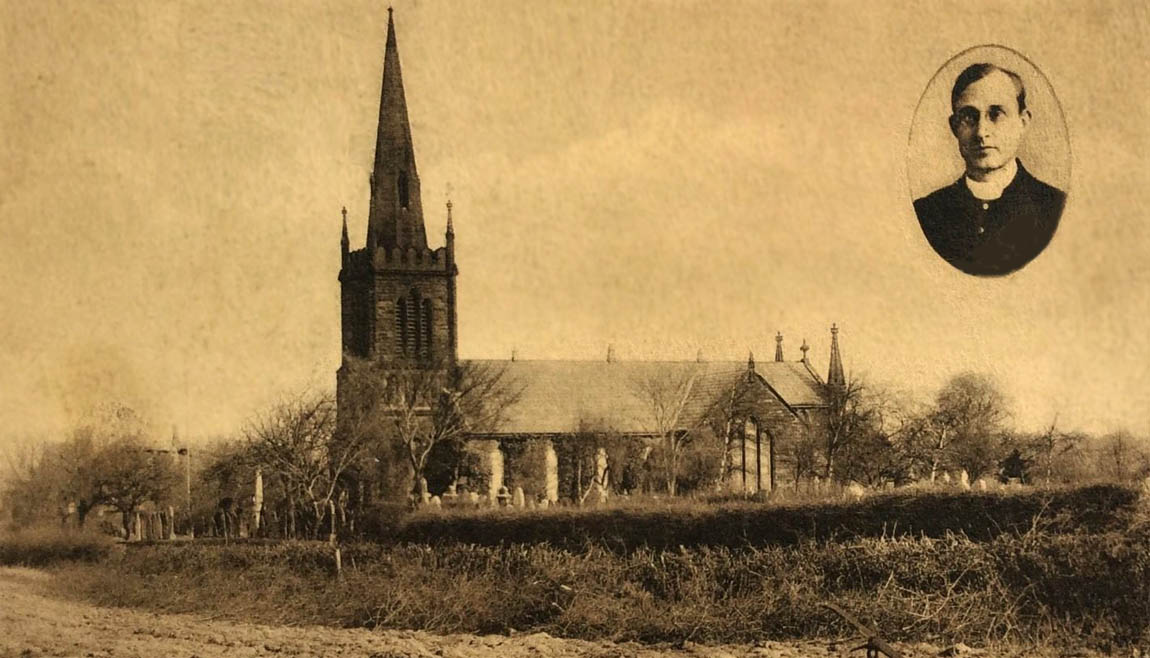 On the 8th the annual field day and sports organised by Christ Church Eccleston (pictured above) were held in bright weather. The event began with the usual procession led by the Church Army Band playing what was described as "lively music". After parading the streets, the procession arrived at the field in Kiln Lane that had been lent for the occasion by James Cooke. A series of athletics events were held and cricket matches and games also took place. During the evening two concerts were given by the Cremona Concert Party and dancing followed until dusk.
It is noticeable that of late the number of acrobatic performers and so-called equilibrists – acrobats who specialised in balancing acts, such as tightrope walking – that were appearing at the Hippodrome Theatre were on the increase. During this week the following turns were treading the boards in Corporation Street, which included three acrobatic acts:
The Horsburgh Bros. ("Sensational comedy and novelty equilibrists"); Ennora ("The up-side-down equilibrist"); Dorothy Penny ("Soprano vocalist"); Farlane & Mac ("Comedians"); Barbe and Barbette ("Society acrobatic dancers") and Arthur Astill and Gwen Fontaine ("In a mimic and ventriloquial scene").
And finally, on the 10th the inquest on Ellen Rigby from Hardy Street was held. That used to be near Waterloo Street in St Helens town centre. It was a very sad case in which the coroner was told that the 52-year-old had never recovered from the death of her husband in 1918. Whether that had been through the war or his occupation wasn't stated but, suffering from depression, Ellen had in 1922 attempted to gas herself and on the previous Thursday she'd hung herself at her home.
St Helens Reporter courtesy St Helens Archive Service at Eccleston Library
Next Week's stories will include the supposedly weak man charged with indecently assaulting a 13-year-old girl, the shabbily-dressed cripple who caused trouble at the White Hart Inn and the grave offence committed against a daughter.
We begin with the St Helens Reporter's mid-week edition on the 4th which announced that the route for the "new arterial road from Liverpool to East Lancashire" had now been fixed. The Lancashire Evening Post in their take on the story called the huge highway the "proposed Liverpool and Manchester or East Lancashire new road". The plan was for a single carriageway 40 ft wide but which would occupy a strip of land 100 ft wide. That would allow for future widening and the provision of footpaths.
The original £3 million scheme had been scrapped after some boroughs along the route had refused to contribute towards it. St Helens Corporation had not been one, as it wanted the heavy traffic that currently passed through the centre of the town to be reduced and for unemployed men to be hired as labourers on the new road. It was hoped that construction work on the revised project could begin later in the year.
These days, of course, the August Bank Holiday is on the last Monday of the month but until 1964 it was held on the first Monday. The Reporter described the many field days that had taken place on the previous day with processions, games, tea and sports being their four essential components. Sherdley Park had separately hosted the Parr Mount and the Holy Trinity, Peasley Cross, field day events, with the Reporter writing:
"Parr Mount were led by the Parr Temperance Band, and Holy Trinity, Peasley Cross by the St. Peter's Prize Band. In addition to the little ones in their pretty white dresses (a number of the little maidens carrying baskets of flowers), the procession included several tableaux, and charming they were. They included a patriotic group of “Britannia” and the nations, England, Ireland, Scotland and Wales, and a dainty load of “fairies,” whilst very picturesque was the miniature “Maypole” and the band of Morris Dancers attired in gypsy costumes."
Some people used to talk so quietly in the witness box in St Helens Police Court that the magistrates had a job to hear what they were saying. Others felt their point could only be made by speaking at the top of their voice! When Gertrude Smoulders of Hills Moss Road in Sutton summoned her next-door neighbour Alice Grice to court this week for using defamatory language, the Reporter said the latter had addressed the Bench in a loud voice for some length of time.
Then she declared: "There has been no peace in the neighbourhood since the Smoulders lived there." To that remark the Magistrates Clerk quipped: "And there doesn't seem to be much peace here where you are." Mrs Smoulders said her husband had gone to see Mrs Grice to complain about statements that she had supposedly made about them.
Mrs Grice had complained that the man was receiving National Health insurance money as well as compensation cash, which, she claimed, he had no right to receive. She was also accused of calling the Smoulders a foul name. The Bench decided to bind Mrs Grice over to be of good behaviour for six months.
The "everybody's got it in for me" excuse did not go down well with the magistrates. Robert Dudley tried that in the Police Court this week after being charged with being drunk and disorderly on the previous night. PC Bennett told the Bench that at 10:35pm while on his beat in Church Street he had been summoned to Grimshaw's lodging house in Salisbury Street.
There he found Robert Dudley creating a disturbance. In company with PC Price he asked the man to leave but he refused and they needed to forcibly eject him. "We got him out but he refused to go home and started dancing in the road and wanted to fight us," the constable explained. "We took him to the police office struggling with us all the way where he was locked up."
"I didn't struggle at all and I was not disorderly", interjected Dudley. "I had just paid my lodgings. I wasn't violent at all. I am not strong enough to be violent. It was they who were violent to me. I don't get a chance. If I come into the town they're after me, and if I stay out I can't get work. I have to come into the town to get work."
Inspector Roe informed the Bench that Dudley had been to court on 19 previous occasions and the police were "constantly" being called to the Salisbury lodging house to evict him. "He is a thorough nuisance", declared the inspector. Dudley was ordered to pay 10 shillings or go to prison for 7 days.
Then a young man, Robert was very likely the elderly individual of the same name that was featured in a St Helens Reporter article from 1970 on men that were living in an old brickworks dubbed "Skid Row" that was about to be bulldozed. Nicknamed "Black Bob" (although white), Robert appeared to have been mellowed by the passage of time as he put on a brave face about his situation, saying: "Why should I worry. I just let the world go by. I don't have anybody to worry about me. And I don't worry about nobody, either. I don't have any bills or rent to pay."
In 1919 when John Kay had appeared in St Helens Police Court the town's Chief Constable called him a "wastrel". Then in May 1925 the Reporter rather unkindly wrote: "Of the queer kind of driftwood that floats occasionally through the local Police Court, John Henry Kay is about the most puzzling. He appeared at Friday's Court wearing a blanket round his shoulders, a three days' growth of beard on his chin, and a wild gleam in his eyes."
The magistrates generally sent Kay to Whiston Institution, which was the new name for the workhouse, as he clearly was a disturbed individual. But when he appeared before them on the 6th, Kay was sent to prison for 3 months with hard labour. That was after he had been found at midnight lying in a cart in Ashcroft Street that belonged to coal dealer William Holding.
In his defence Kay said he was not accountable for his actions because of an accident he had suffered several years ago and he pleaded to be sent back to the workhouse. However, the Chairman of the Bench said that on the last occasion Kay had been before them, he had been sent to the workhouse but had refused to do any work and had been subsequently prosecuted by the Prescot Guardians. And so he was sent to prison and told that if he appeared before them again, Kay would be treated as a rogue and vagabond, which meant being given a very long sentence.
It is noticeable that of late the number of acrobatic performers and so-called equilibrists – acrobats who specialised in balancing acts, such as tightrope walking – that were appearing at the Hippodrome Theatre were on the increase. During this week the following turns were treading the boards in Corporation Street, which included three acrobatic acts:
The Horsburgh Bros. ("Sensational comedy and novelty equilibrists"); Ennora ("The up-side-down equilibrist"); Dorothy Penny ("Soprano vocalist"); Farlane & Mac ("Comedians"); Barbe and Barbette ("Society acrobatic dancers") and Arthur Astill and Gwen Fontaine ("In a mimic and ventriloquial scene").
And finally, on the 10th the inquest on Ellen Rigby from Hardy Street was held. That used to be near Waterloo Street in St Helens town centre. It was a very sad case in which the coroner was told that the 52-year-old had never recovered from the death of her husband in 1918. Whether that had been through the war or his occupation wasn't stated but, suffering from depression, Ellen had in 1922 attempted to gas herself and on the previous Thursday she'd hung herself at her home.
St Helens Reporter courtesy St Helens Archive Service at Eccleston Library
Next Week's stories will include the supposedly weak man charged with indecently assaulting a 13-year-old girl, the shabbily-dressed cripple who caused trouble at the White Hart Inn and the grave offence committed against a daughter.
This week's many stories include the plans for the new East Lancs Road, the August Bank Holiday field days, Black Bob causes trouble at the Salisbury Street lodging house, the bickering neighbours of Hills Moss Road, the wastrel with a wild gleam in his eye receives hard labour, the Eccleston Church Field Day and the equilibrists that were performing at the Hippodrome.
We begin with the St Helens Reporter's mid-week edition on the 4th which announced that the route for the "new arterial road from Liverpool to East Lancashire" had now been fixed.
The Lancashire Evening Post in their take on the story called the huge highway the "proposed Liverpool and Manchester or East Lancashire new road".
The plan was for a single carriageway 40 ft wide but which would occupy a strip of land 100 ft wide. That would allow for future widening and the provision of footpaths.
The original £3 million scheme had been scrapped after some boroughs along the route had refused to contribute towards it.
St Helens Corporation had not been one, as it wanted the heavy traffic that currently passed through the centre of the town to be reduced and for unemployed men to be hired as labourers on the new road.
It was hoped that construction work on the revised project could begin later in the year.
These days, of course, the August Bank Holiday is on the last Monday of the month but until 1964 it was held on the first Monday.
The Reporter described the many field days that had taken place on the previous day with processions, games, tea and sports being their four essential components.
Sherdley Park had separately hosted the Parr Mount and the Holy Trinity, Peasley Cross field day events, with the Reporter writing:
"Parr Mount were led by the Parr Temperance Band, and Holy Trinity, Peasley Cross, by the St. Peter's Prize Band.
"In addition to the little ones in their pretty white dresses (a number of the little maidens carrying baskets of flowers), the procession included several tableaux, and charming they were.
"They included a patriotic group of “Britannia” and the nations, England, Ireland, Scotland and Wales, and a dainty load of “fairies,” whilst very picturesque was the miniature “Maypole” and the band of Morris Dancers attired in gypsy costumes."
Some people used to talk so quietly in the witness box in St Helens Police Court that the magistrates had a job to hear what they were saying. Others felt their point could only be made by speaking at the top of their voice!
When Gertrude Smoulders of Hills Moss Road in Sutton summoned her next-door neighbour Alice Grice to court this week for using defamatory language, the Reporter said the latter had addressed the Bench in a loud voice for some length of time. Then she declared:
"There has been no peace in the neighbourhood since the Smoulders lived there."
To that remark the Magistrates Clerk quipped: "And there doesn't seem to be much peace here where you are."
Mrs Smoulders said her husband had gone to see Mrs Grice to complain about statements that she had supposedly made about them.
Mrs Grice had complained that the man was receiving National Health insurance money as well as compensation cash, which, she claimed, he had no right to receive.
She was also accused of calling the Smoulders a foul name. The Bench decided to bind Mrs Grice over to be of good behaviour for six months.
The "everybody's got it in for me" excuse did not go down well with the magistrates.
Robert Dudley tried that in the Police Court this week after being charged with being drunk and disorderly on the previous night.
PC Bennett told the Bench that at 10:35pm while on his beat in Church Street he had been summoned to Grimshaw's lodging house in Salisbury Street.
There he found Robert Dudley creating a disturbance. In company with PC Price he asked the man to leave but he refused and they needed to forcibly eject him.
"We got him out but he refused to go home and started dancing in the road and wanted to fight us," the constable explained.
"We took him to the police office struggling with us all the way where he was locked up."
"I didn't struggle at all and I was not disorderly", interjected Dudley. "I had just paid my lodgings. I wasn't violent at all. I am not strong enough to be violent.
"It was they who were violent to me. I don't get a chance. If I come into the town they're after me, and if I stay out I can't get work. I have to come into the town to get work."
Inspector Roe informed the Bench that Dudley had been to court on 19 previous occasions and the police were "constantly" being called to the Salisbury lodging house to evict him. "He is a thorough nuisance", declared the inspector.
Dudley was ordered to pay 10 shillings or go to prison for 7 days.
Then a young man, Robert was very likely the elderly individual of the same name that was featured in a St Helens Reporter article from 1970 on men that were living in an old brickworks dubbed "Skid Row" that was about to be bulldozed.
Nicknamed "Black Bob" (although white), Robert appeared to have been mellowed by the passage of time as he put on a brave face about his situation, saying:
"Why should I worry. I just let the world go by. I don't have anybody to worry about me. And I don't worry about nobody, either. I don't have any bills or rent to pay."
In 1919 when John Kay had appeared in St Helens Police Court the town's Chief Constable called him a "wastrel". Then in May 1925 the Reporter rather unkindly wrote:
"Of the queer kind of driftwood that floats occasionally through the local Police Court, John Henry Kay is about the most puzzling. He appeared at Friday's Court wearing a blanket round his shoulders, a three days' growth of beard on his chin, and a wild gleam in his eyes."
The magistrates generally sent Kay to Whiston Institution, which was the new name for the workhouse, as he clearly was a disturbed individual.
But when he appeared before them on the 6th, Kay was sent to prison for 3 months with hard labour.
That was after he had been found at midnight lying in a cart in Ashcroft Street that belonged to coal dealer William Holding.
In his defence Kay said he was not accountable for his actions because of an accident he had suffered several years ago and he pleaded to be sent back to the workhouse.
However, the Chairman of the Bench said that on the last occasion Kay had been before them, he had been sent to the workhouse but had refused to do any work and had subsequently been prosecuted by the Prescot Guardians.
And so he was sent to prison and told that if he appeared before them again, Kay would be treated as a rogue and vagabond, which meant being given a very long sentence.
On the 8th the annual field day and sports organised by Christ Church Eccleston (pictured above) were held in bright weather.
The event began with the usual procession led by the Church Army Band playing what was described as "lively music".
After parading the streets, the procession arrived at the field in Kiln Lane that had been lent for the occasion by James Cooke.
A series of athletics events were held and cricket matches and games also took place.
During the evening two concerts were given by the Cremona Concert Party and dancing followed until dusk.
It is noticeable that of late the number of acrobatic performers and so-called equilibrists – acrobats who specialised in balancing acts, such as tightrope walking – that were appearing at the Hippodrome Theatre were on the increase.
During this week the following turns were treading the boards in Corporation Street, which included three acrobatic acts:
The Horsburgh Bros. ("Sensational comedy and novelty equilibrists"); Ennora ("The up-side-down equilibrist"); Dorothy Penny ("Soprano vocalist"); Farlane & Mac ("Comedians"); Barbe and Barbette ("Society acrobatic dancers") and Arthur Astill and Gwen Fontaine ("In a mimic and ventriloquial scene").
And finally, on the 10th the inquest on Ellen Rigby from Hardy Street was held. That used to be near Waterloo Street in St Helens town centre.
It was a very sad case in which the coroner was told that the 52-year-old had never recovered from the death of her husband in 1918.
Whether that had been through the war or his occupation wasn't stated but, suffering from depression, Ellen had in 1922 attempted to gas herself and on the previous Thursday she'd hung herself at her home.
St Helens Reporter courtesy St Helens Archive Service at Eccleston Library
Next Week's stories will include the supposedly weak man charged with indecently assaulting a 13-year-old girl, the shabbily-dressed cripple who caused trouble at the White Hart Inn and the grave offence committed against a daughter.
We begin with the St Helens Reporter's mid-week edition on the 4th which announced that the route for the "new arterial road from Liverpool to East Lancashire" had now been fixed.
The Lancashire Evening Post in their take on the story called the huge highway the "proposed Liverpool and Manchester or East Lancashire new road".
The plan was for a single carriageway 40 ft wide but which would occupy a strip of land 100 ft wide. That would allow for future widening and the provision of footpaths.
The original £3 million scheme had been scrapped after some boroughs along the route had refused to contribute towards it.
St Helens Corporation had not been one, as it wanted the heavy traffic that currently passed through the centre of the town to be reduced and for unemployed men to be hired as labourers on the new road.
It was hoped that construction work on the revised project could begin later in the year.
These days, of course, the August Bank Holiday is on the last Monday of the month but until 1964 it was held on the first Monday.
The Reporter described the many field days that had taken place on the previous day with processions, games, tea and sports being their four essential components.
Sherdley Park had separately hosted the Parr Mount and the Holy Trinity, Peasley Cross field day events, with the Reporter writing:
"Parr Mount were led by the Parr Temperance Band, and Holy Trinity, Peasley Cross, by the St. Peter's Prize Band.
"In addition to the little ones in their pretty white dresses (a number of the little maidens carrying baskets of flowers), the procession included several tableaux, and charming they were.
"They included a patriotic group of “Britannia” and the nations, England, Ireland, Scotland and Wales, and a dainty load of “fairies,” whilst very picturesque was the miniature “Maypole” and the band of Morris Dancers attired in gypsy costumes."
Some people used to talk so quietly in the witness box in St Helens Police Court that the magistrates had a job to hear what they were saying. Others felt their point could only be made by speaking at the top of their voice!
When Gertrude Smoulders of Hills Moss Road in Sutton summoned her next-door neighbour Alice Grice to court this week for using defamatory language, the Reporter said the latter had addressed the Bench in a loud voice for some length of time. Then she declared:
"There has been no peace in the neighbourhood since the Smoulders lived there."
To that remark the Magistrates Clerk quipped: "And there doesn't seem to be much peace here where you are."
Mrs Smoulders said her husband had gone to see Mrs Grice to complain about statements that she had supposedly made about them.
Mrs Grice had complained that the man was receiving National Health insurance money as well as compensation cash, which, she claimed, he had no right to receive.
She was also accused of calling the Smoulders a foul name. The Bench decided to bind Mrs Grice over to be of good behaviour for six months.
The "everybody's got it in for me" excuse did not go down well with the magistrates.
Robert Dudley tried that in the Police Court this week after being charged with being drunk and disorderly on the previous night.
PC Bennett told the Bench that at 10:35pm while on his beat in Church Street he had been summoned to Grimshaw's lodging house in Salisbury Street.
There he found Robert Dudley creating a disturbance. In company with PC Price he asked the man to leave but he refused and they needed to forcibly eject him.
"We got him out but he refused to go home and started dancing in the road and wanted to fight us," the constable explained.
"We took him to the police office struggling with us all the way where he was locked up."
"I didn't struggle at all and I was not disorderly", interjected Dudley. "I had just paid my lodgings. I wasn't violent at all. I am not strong enough to be violent.
"It was they who were violent to me. I don't get a chance. If I come into the town they're after me, and if I stay out I can't get work. I have to come into the town to get work."
Inspector Roe informed the Bench that Dudley had been to court on 19 previous occasions and the police were "constantly" being called to the Salisbury lodging house to evict him. "He is a thorough nuisance", declared the inspector.
Dudley was ordered to pay 10 shillings or go to prison for 7 days.
Then a young man, Robert was very likely the elderly individual of the same name that was featured in a St Helens Reporter article from 1970 on men that were living in an old brickworks dubbed "Skid Row" that was about to be bulldozed.
Nicknamed "Black Bob" (although white), Robert appeared to have been mellowed by the passage of time as he put on a brave face about his situation, saying:
"Why should I worry. I just let the world go by. I don't have anybody to worry about me. And I don't worry about nobody, either. I don't have any bills or rent to pay."
In 1919 when John Kay had appeared in St Helens Police Court the town's Chief Constable called him a "wastrel". Then in May 1925 the Reporter rather unkindly wrote:
"Of the queer kind of driftwood that floats occasionally through the local Police Court, John Henry Kay is about the most puzzling. He appeared at Friday's Court wearing a blanket round his shoulders, a three days' growth of beard on his chin, and a wild gleam in his eyes."
The magistrates generally sent Kay to Whiston Institution, which was the new name for the workhouse, as he clearly was a disturbed individual.
But when he appeared before them on the 6th, Kay was sent to prison for 3 months with hard labour.
That was after he had been found at midnight lying in a cart in Ashcroft Street that belonged to coal dealer William Holding.
In his defence Kay said he was not accountable for his actions because of an accident he had suffered several years ago and he pleaded to be sent back to the workhouse.
However, the Chairman of the Bench said that on the last occasion Kay had been before them, he had been sent to the workhouse but had refused to do any work and had subsequently been prosecuted by the Prescot Guardians.
And so he was sent to prison and told that if he appeared before them again, Kay would be treated as a rogue and vagabond, which meant being given a very long sentence.
The event began with the usual procession led by the Church Army Band playing what was described as "lively music".
After parading the streets, the procession arrived at the field in Kiln Lane that had been lent for the occasion by James Cooke.
A series of athletics events were held and cricket matches and games also took place.
During the evening two concerts were given by the Cremona Concert Party and dancing followed until dusk.
It is noticeable that of late the number of acrobatic performers and so-called equilibrists – acrobats who specialised in balancing acts, such as tightrope walking – that were appearing at the Hippodrome Theatre were on the increase.
During this week the following turns were treading the boards in Corporation Street, which included three acrobatic acts:
The Horsburgh Bros. ("Sensational comedy and novelty equilibrists"); Ennora ("The up-side-down equilibrist"); Dorothy Penny ("Soprano vocalist"); Farlane & Mac ("Comedians"); Barbe and Barbette ("Society acrobatic dancers") and Arthur Astill and Gwen Fontaine ("In a mimic and ventriloquial scene").
And finally, on the 10th the inquest on Ellen Rigby from Hardy Street was held. That used to be near Waterloo Street in St Helens town centre.
It was a very sad case in which the coroner was told that the 52-year-old had never recovered from the death of her husband in 1918.
Whether that had been through the war or his occupation wasn't stated but, suffering from depression, Ellen had in 1922 attempted to gas herself and on the previous Thursday she'd hung herself at her home.
St Helens Reporter courtesy St Helens Archive Service at Eccleston Library
Next Week's stories will include the supposedly weak man charged with indecently assaulting a 13-year-old girl, the shabbily-dressed cripple who caused trouble at the White Hart Inn and the grave offence committed against a daughter.